

Share this article:
Most brands dump money into celebrity endorsements and hope for the best. Glossier did the opposite, and built a $1.8-2 billion beauty empire almost entirely through everyday customers turned advocates. What started as a beauty blog in 2010 became one of the most studied creator marketing case studies in DTC history, proving that authentic community beats paid reach every time.
The numbers tell the story: 70% of Glossier's online sales came from peer referrals, not polished ad campaigns. Their first year? 79% of revenue from organic and earned sources with zero formal marketing spend. That's not luck, it's a deliberate strategy built on micro-influencers, user-generated content, and community-first thinking.
This breakdown covers how Glossier actually pulled it off: the tactics, the program structures, and the measurable outcomes that make their approach worth studying. If you're running a creator program (or building one from scratch), there's a blueprint here, and the data to back it up.
Key Takeaways
- Peer referrals outperformed paid ads by a massive margin: 70% of Glossier's sales came from peer-to-peer referrals, with 80% of customers specifically referred by friends, proving that authentic advocacy tracking matters more than campaign metrics for DTC brands.
- Micro-influencers deliver dramatically better ROI than macro: Data shows micro-influencers generate +36.71% ROI while macro-influencers (500K-1M followers) actually lose money at -12.04% ROI, a 48-percentage-point difference that should reshape how brands approach creator selection.
- Community-building preceded product launch: Glossier spent four years building Into the Gloss blog to 2-3 million monthly visitors before selling a single product, creating what investors called a market research goldmine through social listening.
- 500 ambassadors drove 90% of brand growth: The Generation Glossier program converted passionate customers into commission-based affiliates, with 8% of sales directly attributed to Instagram ambassador activity, incremental to organic word-of-mouth.
- UGC trust beats brand content: 79% of consumers trust user-generated content more than traditional brand messaging when making purchase decisions, making systematic UGC capture and creator recruitment a competitive advantage.
Understanding the Foundation: What is Influencer Marketing?
Before diving into Glossier's playbook, it helps to ground what influencer marketing actually means in 2026, because it's changed quite a bit from the early celebrity endorsement days.
Defining Modern Influencer Campaigns
At its core, influencer marketing means partnering with individuals who have built trust with a specific audience to promote your brand. But the "who" has shifted dramatically. The industry grew from $1.7 billion in 2016 to $24 billion in 2024, representing 33% compound annual growth. Social media even surpassed paid search as the largest advertising channel at $247.3 billion global spend.
The influencer spectrum breaks down roughly like this:
- Nano-influencers (1K-10K followers): Highest engagement rates, most authentic relationships with followers
- Micro-influencers (10K-100K followers): Sweet spot for most DTC brands, affordable, targeted, measurable
- Macro-influencers (100K-1M followers): Broader reach but declining authenticity and engagement
- Mega/Celebrity (1M+ followers): Mass awareness plays, typically $1M+ per post in beauty
What's worth noting: the data increasingly favors the smaller end of this spectrum. Glossier figured this out early and built their entire strategy around it.
The Evolution of Digital Word-of-Mouth
Traditional advertising talks at consumers. Modern influencer marketing works because it replicates the most powerful purchase driver: recommendations from people we trust.
Harvard Business School recognized Glossier as one of the first socially driven brands that merchandises community as much as products. That academic validation matters, it signals a fundamental shift in how brands should think about customer relationships.
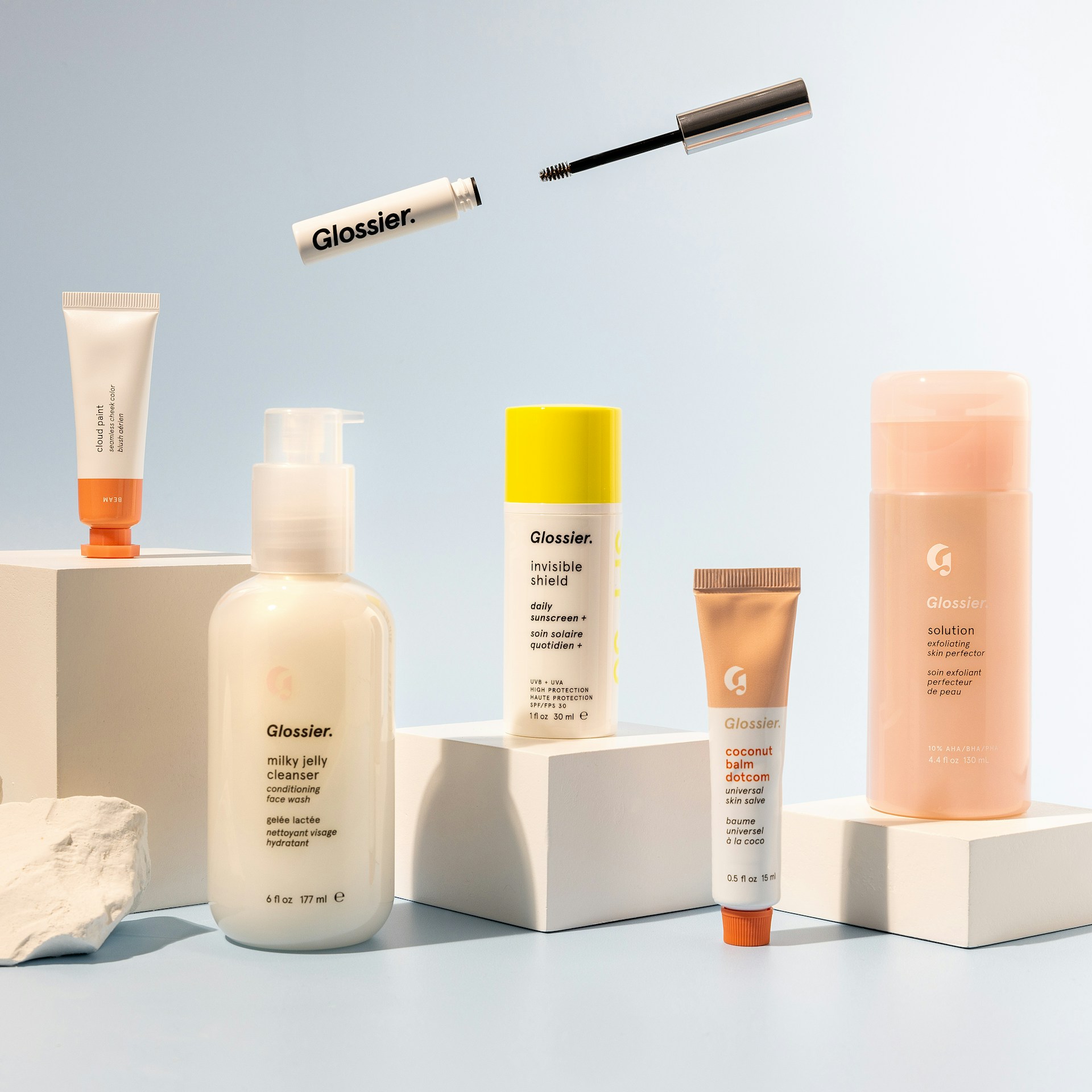
The key insight: tracking authentic conversations about your brand (through social listening) often reveals more about product-market fit than any focus group ever could. Glossier built products like Boy Brow and Milky Jelly Cleanser directly from community feedback documented in blog comments.
Glossier's Pioneering Approach to Beauty Industry Influencer Marketing
Glossier didn't stumble into community-driven marketing. They spent four years laying the groundwork before launching a single product.
From Blog to Billion-Dollar Brand: The Glossier Story
Emily Weiss started Into the Gloss in 2010 as a beauty blog featuring interviews with women about their skincare routines. By 2014, when Glossier finally launched products, the blog was pulling 2-3 million monthly visitors and generating 300+ substantive comments on product-sourcing posts.
Investors called the blog a market research goldmine, and they weren't exaggerating. Every product decision came from community conversations, not boardroom assumptions.
The timeline matters:
- 2010-2014: Community building (Into the Gloss blog)
- 2014: First product launch with built-in audience
- 2015: 79% of first-year sales from organic sources
- 2019: $1.2 billion valuation
- 2021: Peak valuation of $1.8-2 billion
Most brands build products first, then scramble to find customers. Glossier flipped that script entirely.
How Glossier Championed Authentic UGC
User-generated content wasn't an afterthought for Glossier, it was the entire marketing engine.
The philosophy shaped everything from product packaging (customizable stickers designed to encourage content creation) to their Instagram strategy (reposting customer content to 3M+ followers).
The UGC trust premium is real: 79% of consumers trust user-generated content more than brand content when making purchase decisions. Glossier didn't just accept UGC, they engineered systems to generate it at scale.
Their UGC flywheel worked like this:
- Products ship with customizable stickers encouraging photo-worthy unboxings
- Brand monitors hashtags and reposts best customer content
- Weekly "Top 5" Instagram Stories highlight standout UGC
- High-quality content creators get invited to ambassador program
- Ambassadors create more content, attracting more customers
This self-perpetuating cycle is exactly why tracking community content matters so much. You can't recruit your best creators if you don't know who they are.
Building an Army: Glossier's Micro-Influencer Marketing Strategy
Here's where Glossier's approach gets tactically interesting. They deliberately avoided the middle of the influencer spectrum and went small, really small.
The Power of Everyday Advocates
The data supporting micro-influencer strategies is pretty stark. Micro-influencers (1K-100K followers) deliver +36.71% ROI, while macro-influencers (500K-1M) generate -12.04% ROI. That's nearly a 49-percentage-point difference.
Glossier saw 3X higher engagement with micro-influencers compared to celebrities. They also found micro-influencers willing to participate in affiliate-only collaborations, no upfront payments required, making the economics even more favorable for a growing brand.
Why micro-influencers outperform:
- Higher trust within niche communities
- Better engagement rates (followers actually see and interact with posts)
- More cost-effective reach
- Authentic relationships with audiences
- Willingness to work on performance-based terms
The challenge? Finding these creators at scale. Manual vetting doesn't work when you need to identify 50-100 potential partners. This is where creator discovery becomes essential, helping brands surface overlooked creators who already love the product.
Scaling Influence with Authentic Voices
Glossier's "barbell strategy" is worth understanding. They deliberately avoided macro-influencers entirely, focusing exclusively on:
- One end: High-volume, low-cost micro-influencers on affiliate-only terms
- Other end: Occasional celebrity partnerships only after establishing authentic relationships
They didn't bring on celebrity ambassador Olivia Rodrigo until reaching $1.2B valuation and unicorn status, and importantly, Rodrigo was already an authentic customer before the partnership. That's why the collaboration generated 2M+ views and felt genuine rather than manufactured.
For brands without Glossier's scale, this means: don't chase reach you can't afford. Build your base with micro-creators who genuinely care about your product, then graduate to broader partnerships when you've proven the model works.
Beyond the Post: Glossier's Brand Ambassador and Affiliate Programs
One-off influencer posts generate spikes. Ambassador programs generate sustained growth. Glossier understood this distinction early.
Cultivating Lifelong Brand Advocates
The Generation Glossier ambassador program converts passionate customers into commission-based affiliates. 500 brand ambassadors are credited with driving 90% of Glossier's growth, with 8% of online sales directly attributed to Instagram ambassador activity.
What ambassadors receive:
- Unique promo codes for tracking
- Product seeding and early access to launches
- Invitations to exclusive events
- Commission on referred sales
What Glossier gets:
- Consistent content creation
- Authentic word-of-mouth
- Trackable attribution
- A built-in focus group
The program specifically targets micro and nano-influencers for higher trust and engagement within niche communities and cost-effective reach. This isn't about chasing follower counts, it's about finding people who genuinely connect with the brand.
If you're running a brand ambassador program, the key lesson here is structure. Random gifting doesn't scale. Systematic programs with clear tiers, trackable codes, and consistent communication do.
Structuring Effective Ambassador Tiers
Glossier's approach worked because it created clear pathways from customer to advocate:
- Customer posts organically → Brand notices via social listening
- High-quality content flagged → Outreach for ambassador program
- Ambassador receives benefits → Creates more content
- Top performers identified → Potential upgrade to paid partnerships
This pipeline requires infrastructure. You need to track mentions to find organic advocates. You need campaign dashboards to measure ambassador performance. And you need systematic outreach to convert one-time posters into long-term partners.
Measuring Impact: Proving ROI in Influencer Marketing
One of the biggest problems in creator marketing is attribution. Glossier cracked this with clear tracking mechanisms, and the results speak for themselves.
Key Performance Indicators for Creator Campaigns
The metrics that matter for influencer programs go beyond vanity stats:
- Peer referral rate: 70% of Glossier's sales came from peer-to-peer referrals
- Friend-referred customers: 80% of customers were referred by friends
- Ambassador-attributed sales: 8% directly from Instagram ambassadors
- First-year organic percentage: 79% from organic sources
Notice what's not on this list: follower counts, impressions, potential reach. Glossier focused relentlessly on conversion metrics because that's what actually matters for business growth.
Metrics to track for your own program:
- Conversion rate by creator
- Revenue attributed to affiliate codes
- Customer acquisition cost by channel
- Lifetime value of referred customers
- Content volume and quality over time
Attributing Success Beyond Likes
The challenge with influencer marketing is separating paid impact from organic word-of-mouth. Glossier's unique promo codes created clear attribution pathways, if a customer used an ambassador's code, the sale tracked directly.
But here's the thing: that 8% attributed to Instagram ambassadors was incremental to the 70% coming from general peer referrals. The ambassador program amplified organic advocacy rather than replacing it.
For proving influencer marketing ROI to leadership, you need both:
- Direct attribution: Sales traced to specific creators via codes, links, or UTMs
- Lift measurement: Overall referral and organic traffic changes during campaigns
This is exactly why campaign reporting matters. You need to show what's working, and more importantly, what to scale next.
Seamless Social: Integrating Influencer Content into Social Media Marketing
Glossier didn't treat influencer content as a separate silo. It was the fuel for their entire social strategy.
Amplifying Creator Content Across Channels
The brand's Instagram feed became a curated gallery of customer content. With 3M+ followers, every repost gave creators massive exposure, which incentivized more content creation.
Their content repurposing system:
- Best UGC featured on brand Instagram
- Weekly "Top 5" Stories highlight standout creators
- Customer photos used in email marketing
- UGC integrated into product pages
- Creator content adapted for paid ads
This requires capturing usage rights systematically. You can't repurpose content legally without permission, and you can't request permission if you don't know the content exists in the first place.
Building a Cohesive Social Narrative
Glossier's social presence felt cohesive because everything came from the same source: real customers. There's no disconnect between brand messaging and community voice when your community is your messaging.
That engagement requires constant listening. Social listening tools let you monitor what people are actually saying about your brand, not just tagged posts, but the broader conversation.
Automating Success: Tools for Streamlining Influencer Marketing Strategy
Manual creator management doesn't scale. Glossier had dedicated community teams monitoring branded hashtags, running weekly content selections, and recruiting ambassadors. Most brands can't staff that way, which is where automation becomes essential.
Reducing Manual Work in Creator Campaigns
The pain points in creator marketing are predictable:
- Screenshotting Stories before they disappear
- Tracking everything in Excel
- Jumping between platforms to find posts
- Missing content that slips through the cracks
- Hodgepodging numbers together for reports
Glossier solved these with a dedicated headcount. For everyone else, the answer is infrastructure that captures content automatically and surfaces what matters.
What automation should handle:
- Detecting all tagged content across platforms
- Flagging high-quality UGC for review
- Tracking creator performance over time
- Generating reports for leadership
- Identifying top performers and lookalikes
The Role of Technology in Scaling Influence
The technical requirements for replicating Glossier's approach at scale include:
- UGC monitoring: Automatic detection of brand mentions and tagged content
- Quality scoring: AI-powered assessment of content potential
- Creator CRM: Tracking relationships and performance over time
- Attribution: Connecting creator content to sales outcomes
- Reporting: Proving ROI to stakeholders
Even Glossier, with exceptional community infrastructure, has gaps. A brand audit revealed that their emails land in Promotions tabs (not Primary inbox) due to image-heavy design, their SMS channel is completely inactive despite subscriber consent, and they have zero personalization despite having skin-type data. These infrastructure gaps represent "multi-million dollar" revenue leakage.
The lesson: building community is necessary but not sufficient. You also need systems to capitalize on it.
Building Your Own Glossier: Crafting an Effective Influencer Marketing Strategy
Glossier's playbook isn't magic, it's a set of repeatable principles. Here's how to apply them.
Developing a Vision for Creator Partnerships
Start with clarity on what you're trying to achieve:
If your goal is brand awareness:
- Focus on content volume and reach
- Prioritize creators with engaged audiences in your category
- Track impressions and engagement growth
If your goal is sales:
- Focus on conversion-optimized partnerships
- Prioritize creators with proven sales track records
- Track attributed revenue and CAC
If your goal is content creation:
- Focus on quality and usability of creator output
- Prioritize creators who produce on-brand aesthetics
- Track content volume and repurposing rates
Glossier wanted all three, but they sequenced correctly. Community and content came first. Sales followed naturally.
From Planning to Execution: A Step-by-Step Guide
Phase 1: Foundation (Months 1-3)
- Set up social listening to capture community posts
- Identify organic advocates already creating content
- Establish baseline metrics for referral and organic traffic
- Build outreach templates and ambassador program structure
Phase 2: Activation (Months 4-6)
- Reach out to top organic creators
- Launch ambassador program with clear tiers and benefits
- Create systems for tracking performance
- Begin systematic content repurposing
Phase 3: Scale (Months 7-12)
- Expand creator recruitment based on performance data
- Use lookalike discovery to find creators similar to top performers
- Build reporting infrastructure for leadership
- Optimize based on what's actually driving results
Phase 4: Optimization (Ongoing)
- Double down on top-performing creator segments
- Test new partnership models
- Expand to additional platforms based on audience behavior
- Continuously refine based on attribution data
Brand Safety and Risk Management
One lesson from Glossier's experience: even community-first brands face risks. Influencer marketing involves taking risks on the content side, in order to be persuasive, influencers have to speak in their own voice.
Mitigating creator risk:
- Vet creator history before partnerships (not just recent posts)
- Establish clear content guidelines without killing authenticity
- Monitor ongoing creator content for brand alignment
- Have response protocols for controversial situations
The Glossier Play sub-brand failed within one year because it contradicted the "natural, effortless" positioning that their community loved. Even strong community relationships don't protect against strategic misalignment.
Frequently Asked Questions
How long did it take Glossier to build their influencer marketing foundation?
Glossier spent four years (2010-2014) building the Into the Gloss blog and community before launching any products. By the time they started selling, they already had 2-3 million monthly visitors and deep insights into what their audience wanted. Most brands won't have that runway, but the principle holds: community-building takes time, and shortcuts rarely work. Even launching with a smaller audience that genuinely cares beats a large audience with no engagement.
What's the minimum budget to replicate Glossier's micro-influencer approach?
Glossier's early strategy was remarkably capital-efficient. During their first year, 79% of sales came from organic sources with essentially zero formal marketing spend. The Generation Glossier program uses commission-based compensation, meaning ambassadors earn when they drive sales rather than receiving upfront payments. For brands with limited budgets, this affiliate-only model works, you just need enough product for seeding and systems to track performance. The real investment is time: identifying the right creators, building relationships, and managing the program consistently.
How did Glossier handle negative UGC or brand safety issues?
Glossier's approach to authenticity meant accepting some loss of message control. They didn't heavily police creator content because influencers need to speak in their own voice to be persuasive. That said, the brand benefited from a genuine product-market fit, their customers actually loved the products, so negative content was relatively rare. For brands concerned about safety, vetting creator history before partnerships (not just recent posts) and establishing clear guidelines help mitigate risk without killing authenticity.
Why did Glossier wait so long to partner with celebrities?
Glossier deliberately avoided celebrity and macro-influencer partnerships until reaching unicorn status ($1.2 billion valuation). The data supported this choice: macro-influencers generate -12.04% ROI compared to +36.71% for micro-influencers. When they finally partnered with Olivia Rodrigo, she was already an authentic customer, not a paid spokesperson discovering the brand on camera. That authenticity is why the partnership generated 2M+ views and felt genuine rather than manufactured.
What metrics should I track if I can't measure sales attribution directly?
If you don't have affiliate codes or direct attribution, focus on leading indicators: engagement rate trends, content volume from organic creators, branded hashtag growth, and referral traffic patterns. Glossier tracked 70% of sales from peer referrals, but they also monitored qualitative signals, comment quality on Into the Gloss, customer participation in product development discussions, and the rate at which customers became repeat buyers. These upstream metrics often predict downstream sales impact, even when direct attribution isn't possible.
How do I find micro-influencers who already love my brand?
Start with your own community. Monitor who's already tagging your brand, using your hashtags, or posting about your products organically. These creators have authentic enthusiasm that paid partnerships can't replicate. Glossier's "Top 5" weekly Stories feature highlighted best UGC, which both rewarded creators and surfaced ambassador candidates. The challenge at scale is capturing all this content, social listening tools help by automatically detecting mentions across platforms, including Stories that disappear after 24 hours.
What should I avoid when building an ambassador program?
The biggest mistakes: launching without clear tracking (you can't prove ROI without attribution), expecting immediate results (community takes time to build), over-controlling creator content (authenticity drives trust), and ignoring your existing customers (your best ambassadors are already buying from you). Glossier also demonstrated what not to do with brand extensions, their Glossier Play sub-brand failed within a year because it contradicted their established positioning. Stay consistent with what your community actually values.

.jpg)

Ready to stop running creator marketing manually?
In just 30 minutes, we’ll show you how Archive helps you track everything, automate the manual work, and prove what’s really working on social.
Book a Demo


